Home · Devotions
Every day at 3:00 p.m. · Hour of Mercy
Jesus, I trust in You
The prayer Jesus taught Saint Faustina Kowalska to implore God’s mercy on us and on the whole world. It is prayed on ordinary rosary beads, in about 10 minutes.
Vilnius, September 13 and 14, 1935
Saint Faustina tells it in her Diary (nos. 474-476). On September 13, 1935, in Vilnius, she saw “an Angel, the executor of divine wrath,” sent to punish the earth, and found herself “pleading with God for the world with words heard interiorly.” As she prayed, the Angel “could not carry out the just punishment.”
The next day, the feast of the Exaltation of the Holy Cross, Jesus taught her in the chapel how to pray this prayer on rosary beads (Diary 476).
Step by step, with rosary beads
1
In the name of the Father, and of the Son, and of the Holy Spirit. Amen.
2
You expired, Jesus, but the source of life gushed forth for souls, and the ocean of mercy opened up for the whole world. O Fount of Life, unfathomable Divine Mercy, envelop the whole world and empty Yourself out upon us.
3
O Blood and Water, which gushed forth from the Heart of Jesus as a fountain of Mercy for us, I trust in You!
4
Our Father, Who art in heaven, Hallowed be Thy Name. Thy Kingdom come. Thy Will be done, on earth as it is in Heaven. Give us this day our daily bread. And forgive us our trespasses, as we forgive those who trespass against us. And lead us not into temptation, but deliver us from evil. Amen.
Hail Mary, full of grace. The Lord is with thee. Blessed art thou amongst women, and blessed is the fruit of thy womb, Jesus.
Holy Mary, Mother of God, pray for us sinners, now and at the hour of our death. Amen.
I believe in God, the Father almighty, Creator of heaven and earth, and in Jesus Christ, his only Son, our Lord, who was conceived by the Holy Spirit, born of the Virgin Mary, suffered under Pontius Pilate, was crucified, died and was buried; he descended into hell; on the third day he rose again from the dead; he ascended into heaven, and is seated at the right hand of God the Father almighty; from there he will come to judge the living and the dead. I believe in the Holy Spirit, the holy catholic Church, the communion of saints, the forgiveness of sins, the resurrection of the body, and life everlasting. Amen.
5
V. Eternal Father, I offer You the Body and Blood, Soul and Divinity of Your dearly beloved Son, Our Lord Jesus Christ,
R. in atonement for our sins and those of the whole world.
6
V. For the sake of His sorrowful Passion,
R. have mercy on us and on the whole world.
Repeat steps 5 and 6 for all five decades.
7
Holy God, Holy Mighty One, Holy Immortal One, have mercy on us and on the whole world.
8
Eternal God, in whom mercy is endless and the treasury of compassion inexhaustible, look kindly upon us and increase Your mercy in us, that in difficult moments we might not despair nor become despondent, but with great confidence submit ourselves to Your holy will, which is Love and Mercy itself. Amen.
From the Diary of Saint Faustina
Diary 687
“Whoever will recite it will receive great mercy at the hour of death. Priests will recommend it to sinners as their last hope of salvation. Even if there were a sinner most hardened, if he were to recite this chaplet only once, he would receive grace from My infinite mercy.”
Diary 811
“At the hour of their death, I defend as My own glory every soul that will say this chaplet; or when others say it for a dying person, the indulgence is the same.”
Diary 1541
“When they say this chaplet in the presence of the dying, I will stand between My Father and the dying person, not as the just Judge but as the merciful Savior.”
Diary 1731
“Through the chaplet you will obtain everything, if what you ask for is compatible with My will.”
Three o’clock in the afternoon
At three in the afternoon, the hour of Jesus’ death on the Cross, He asked Saint Faustina: “At three o’clock, implore My mercy, especially for sinners; and, if only for a brief moment, immerse yourself in My Passion.” “This is the hour of great mercy for the whole world. … In this hour, I will refuse nothing to the soul that makes a request of Me in virtue of My Passion” (Diary 1320).
“Try your best to make the Stations of the Cross in this hour, provided that your duties permit it; and if you are not able to make the Stations of the Cross, then at least step into the chapel for a moment and adore, in the Blessed Sacrament, My Heart, which is full of mercy; and should you be unable to step into the chapel, immerse yourself in prayer there where you happen to be, if only for a very brief instant” (Diary 1572).
Starting on Good Friday
Jesus asked Saint Faustina for a novena that begins on Good Friday and prepares for the Feast of Divine Mercy. Each day a group of souls is brought to His merciful Heart, and the day ends with the Chaplet (Diary 1209-1229).
Day 1
All mankind, especially sinners
Day 2
The souls of priests and religious
Day 3
All devout and faithful souls
Day 4
Those who do not believe in God and those who do not yet know Jesus
Day 5
The souls who have separated themselves from the Church
Day 6
The meek and humble souls and the souls of little children
Day 7
The souls who especially venerate and glorify His mercy
Day 8
The souls detained in purgatory
Day 9
Souls who have become lukewarm
Second Sunday of Easter
On April 30, 2000, at the canonization of Saint Faustina, Saint John Paul II proclaimed that throughout the Church the Second Sunday of Easter would be called “Divine Mercy Sunday.”
Jesus promised: “The soul that will go to Confession and receive Holy Communion shall obtain complete forgiveness of sins and punishment” (Diary 699).
Diary of Saint Faustina
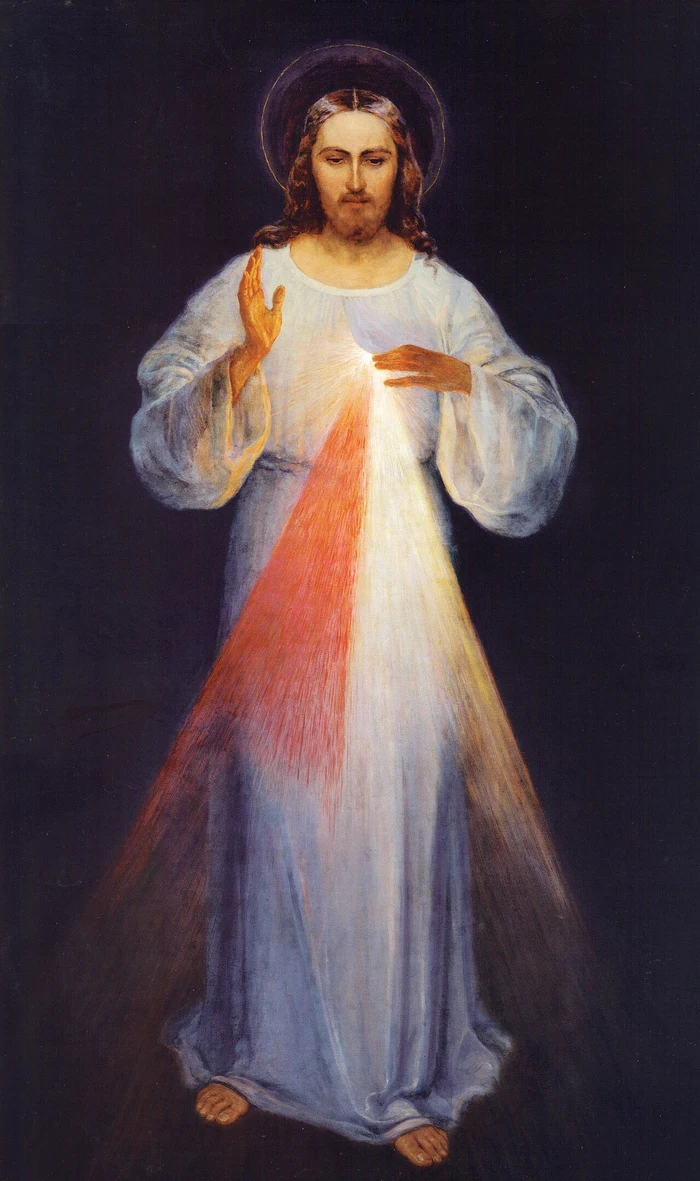
Jesus stands with one hand raised in blessing and the other on His breast, from which two rays come forth: one pale and one red. “The two rays denote Blood and Water” (Diary 299), which flowed from His side opened on the Cross (cf. Jn 19:34).
At the bottom, the signature “Jesus, I trust in You.” The first painting was made by Eugeniusz Kazimirowski in Vilnius in 1934, under the direction of Saint Faustina herself: it is the one you see on this page.
Image: Eugeniusz Kazimirowski, Vilnius, 1934. Public domain (Wikimedia Commons).
Apostle of Divine Mercy
Born on August 25, 1905 in Głogowiec (Poland), she died in Kraków on October 5, 1938. She was beatified in 1993 and canonized by Saint John Paul II on April 30, 2000.